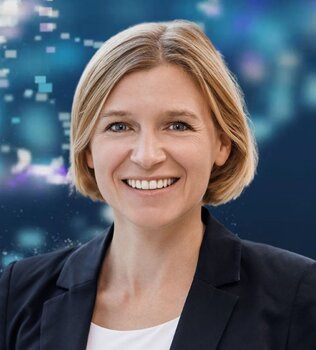
Prof. Dr. Carola Schulz
Professor for Supply Chain Management | Hochschule Heilbronn
Prof. Dr. Carola Schulz studied Industrial Engineering and Management at the University of Karlsruhe (TH) and further specialized in logistics and transportation at the University of British Columbia in Vancouver, Canada. In addition, she completed a supplementary program in Applied Cultural Studies.
She subsequently worked as a research associate at the Institute for Economic Policy and Economic Research (later ECON) and at the Center for Disaster Management and Risk Reduction Technology (CEDIM) at the Karlsruhe Institute of Technology (KIT). Her research focus and doctoral work centered on natural hazards and their impacts on transportation systems and critical infrastructures. In the course of numerous policy advisory projects, she addressed a wide range of topics related to transportation and environmental policy. She was also actively involved in teaching as well as in the organization of conferences and summer schools.
After completing her doctorate, she moved into industry and worked as a logistics planner/project manager for a major automotive supplier in the Automotive Aftermarket division. In this role, she was involved in projects related to warehouse tenders, warehouse relocations, warehouse controlling, and supply chain planning. Prior to her appointment at Heilbronn University and assuming the professorship in General Business Administration and Supply Chain Management, she was responsible for the IT project management of a large-scale warehouse expansion and modernization project.
In addition to her responsibilities in research and teaching, Prof. Dr. Schulz is highly engaged in academic self-governance. Since 2020, she has headed the internship office of her faculty; since 2021, she has been the director of the Master's programs in Transport and Logistics Management and Supply Chain Management; and since 2026, she has led the Heilbronn University Graduate School.
Her current research interests include the digitalization of logistics processes and activities, the resulting transformation of occupational profiles, the impact of the circular economy on supply chains, and sustainable logistics.