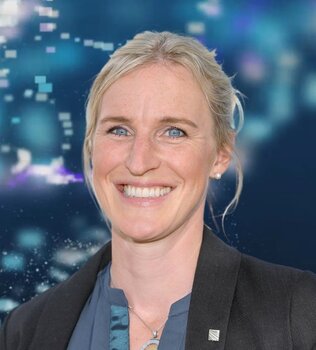
Prof. Dr. Julia Arlinghaus
Director - Institute of Production and Supply Chain Management | Universität St.Gallen
Scientific Advisory Board
Prof. Dr. Julia Arlinghaus is Chair of Logistics and Supply Chain Management and Director of the Institute of Production and Supply Chain Management at the University of St.Gallen. She is also Chair of the Scientific Commission of the German Science Council, the most important advisory body to the German Federal Government on strategic issues concerning the science and higher-education system. Previously, she served for six years as Director of the Fraunhofer Institute for Factory Operation and Automation IFF and held the Chair of Production Systems and Automation at Otto von Guericke University Magdeburg. From 2017 to 2019, she held the Chair of Industry 4.0 Management at RWTH Aachen University – Germany’s first professorship explicitly dedicated to managing the Fourth Industrial Revolution.
After studying industrial engineering at the University of Bremen and the University of Tokyo, she received her PhD in 2011 from the University of St.Gallen, Switzerland. She subsequently worked as a consultant for operational excellence and lean management at Porsche Consulting before accepting a call in 2013 as Professor of Network Optimization in Production and Logistics at Jacobs University Bremen.
Together with her team, she researches—with and for companies—individual, sustainable, and resilient solutions for the efficient design of global value chains. Her research focuses on new technologies and business models in logistics and manufacturing, methods of artificial intelligence, and new approaches to planning and control for digital and circular value creation systems.
Main Stage
Calibrated Trust: Who Controls the Agent-Based Supply Chain—Humans or Machines?
The supply chain of tomorrow needs people who can do more than just press buttons. AI makes suggestions, robots take action—people must design, evaluate, and take responsibility. The problem: true judgment comes from real-world experience, which the younger generation no longer gains in the same way as previous generations. This poses a dilemma for training, recruiting, continuing education, and process design.
What it’s all about:
• Which core competencies really matter?
• How must training and continuing education be reimagined?
• How can companies create processes so that people don’t trust blindly—but also don’t reflexively question everything?
Goal: Calibrated Trust—leadership that instills the right level of trust in AI so that decisions remain accountable.
Prof. Dr. Julia Arlinghaus from the University of St. Gallen and Dr. Inga-Lena Darkow, drawing on their industry experience, will present several proposals on this topic and engage in a discussion with the audience.