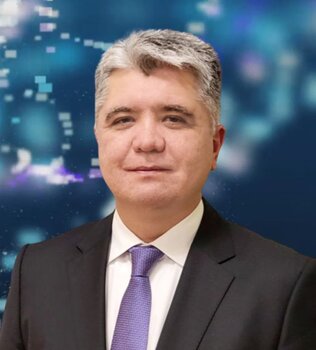
Dilshod Akhatov
Ambassador Extraordinary and Plenipotentiary | Embassy of the Republic of Uzbekistan to the Federal Republic of Germany
Berufliche Laufbahn
1995-1999 Intern, Referent, Attaché of the Department of European Countries of the Ministry of Foreign Affairs of the Republic of Uzbekistan;
1999-2003 Attaché, Third secretary of the Embassy of the Republic of Uzbekistan to Germany;
2003-2005 Head of the Division of the Department of European Countries of the Ministry of Foreign Affairs of the Republic of Uzbekistan;
2005-2010 Head of the Division, Head of the Department for Cooperation with European countries and NATO of the Ministry of Foreign Affairs of the Republic of Uzbekistan;
2010-2013 Ambassador Extraordinary and Plenipotentiary of the Republic of Uzbekistan to the Federal Republic of Germany;
2013-2016 Head of the Department of the UN and International Organizations of the Ministry of Foreign Affairs of the Republic of Uzbekistan;
2016-2018 Head of the Department for Cooperation with European Countries and NATO of the Ministry of Foreign Affairs of the Republic of Uzbekistan;
2018 Head of the Main Directorate for Bilateral Cooperation of the Ministry of Foreign Affairs of the Republic of Uzbekistan;
2018-2020 Deputy Minister of Foreign Affairs of the Republic of Uzbekistan;
2020-2023 Ambassador Extraordinary and Plenipotentiary of the Republic of Uzbekistan to India;
2023-present Ambassador Extraordinary and Plenipotentiary of the Republic of Uzbekistan to the Federal Republic of Germany
Kaleidoscope Stage
Ambassador's Talk „Neue Routen – neue Märkte: Der mittlere Transportkorridor als Wachstumsmotor für die wirtschaftliche Entwicklung im Südkaukasus und in Zentralasien“
Störungen in den globalen Lieferketten veranlassen die Suche nach alternativen Routen. Eine dieser Routen, der Mittlere Korridor, verbindet China und Zentralasien über das Kaspische Meer, den Südkaukasus und die Türkei oder das Schwarze Meer mit Europa. Obwohl diese Route kostspieliger und langsamer ist, fördert sie die regionale Konnektivität und den Handel, insbesondere zwischen Zentralasien, dem Südkaukasus und der EU. Das dynamische Wachstum, die reichen Ressourcen und die junge Bevölkerung der Region ziehen ausländische Investitionen an. Der Handel innerhalb der Region ist um 37 % gestiegen, der Handel mit der EU um 28 %. Der Korridor bietet deutschen Unternehmen Chancen in den Bereichen Infrastruktur, Hafentechnologie und Energie. Der Ambassador's Talk wird diese Perspektiven beleuchten.